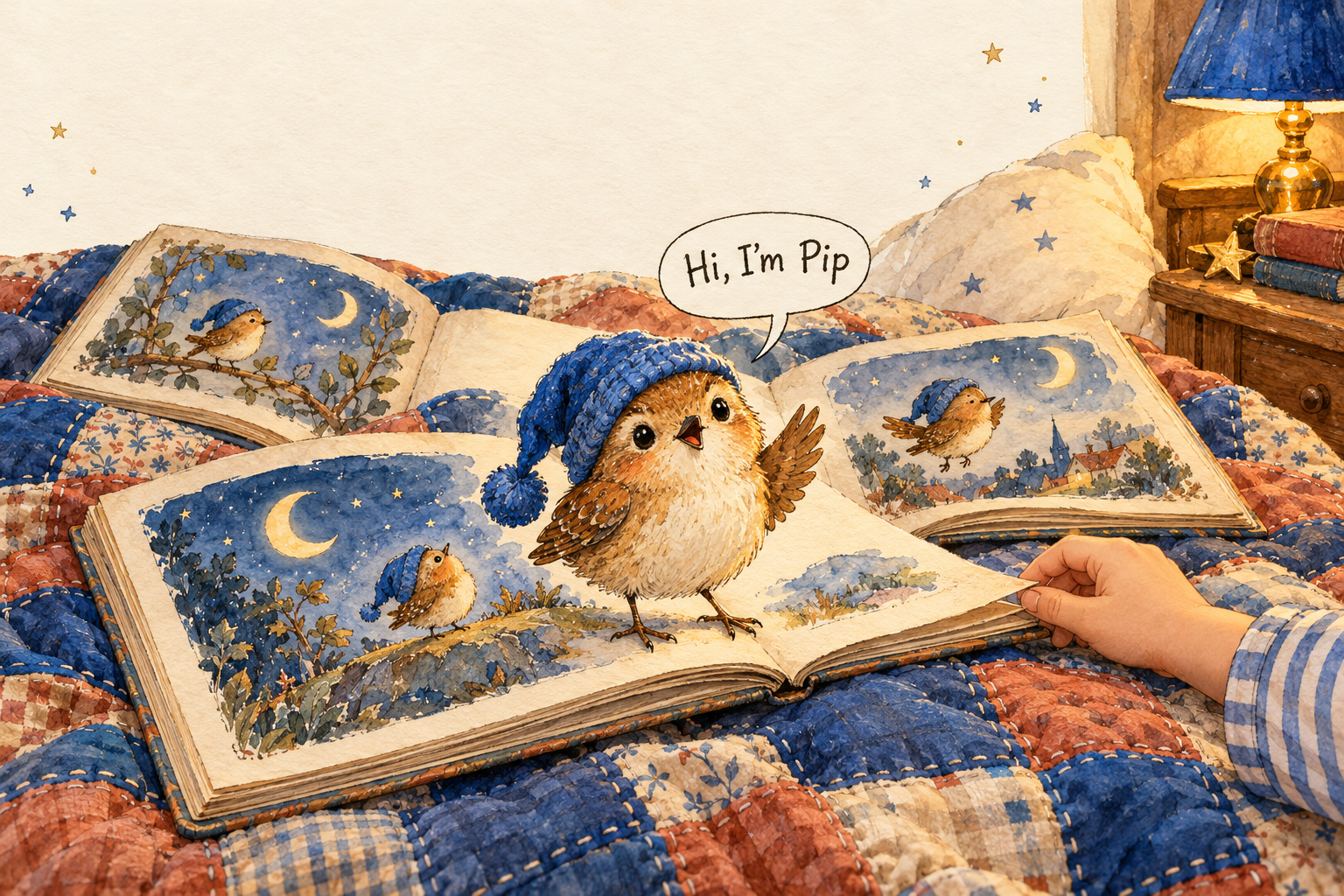
I read my kids bedtime stories. So I started using AI to create bedtime stories for us.
Then we started to notice something. Different AI tools, very very similar stories. There always seemed to be a character named Pip. Or something like “The moon who thought he was cheese”. The X who did or didn't do X.
Nothing wrong with the stories. But after a while you start to think, haven't we read this one already?
You can run into the same thing when you ask AI for marketing ideas for your business. The answer sounds fine. Professional even. But swap your business name for the one down the road and it still works.
So how do you get past that?
Why does it keep giving us the same ideas?
Researchers use the term mode collapse for a loss of variety in AI responses. In simple terms, there are lots of possible answers but the model keeps favouring a smaller set of familiar ones. Research suggests the training used to make models helpful can contribute to this.
That doesn't mean every familiar bedtime story proves mode collapse. But there is research behind the broader concern. In a 2024 study of short stories, access to AI ideas helped people write stories that were rated more creative, while making the stories more similar to one another.
Better individually, more alike as a group. You can see why that might become a problem when everyone in your industry is using AI to write their adverts.
I have written about skills and how you can use them to get more consistent outcomes. But when you want something more interesting, more novel, to the extent we can call anything AI does novel, you have to push it a little.
Number one: ask for directions before asking for the answer
The technique I use for the stories is quite mundane. I ask for five themes, then ask it to select the least obvious one.
Here's a ChatGPT example put together for this post. The first prompt was:
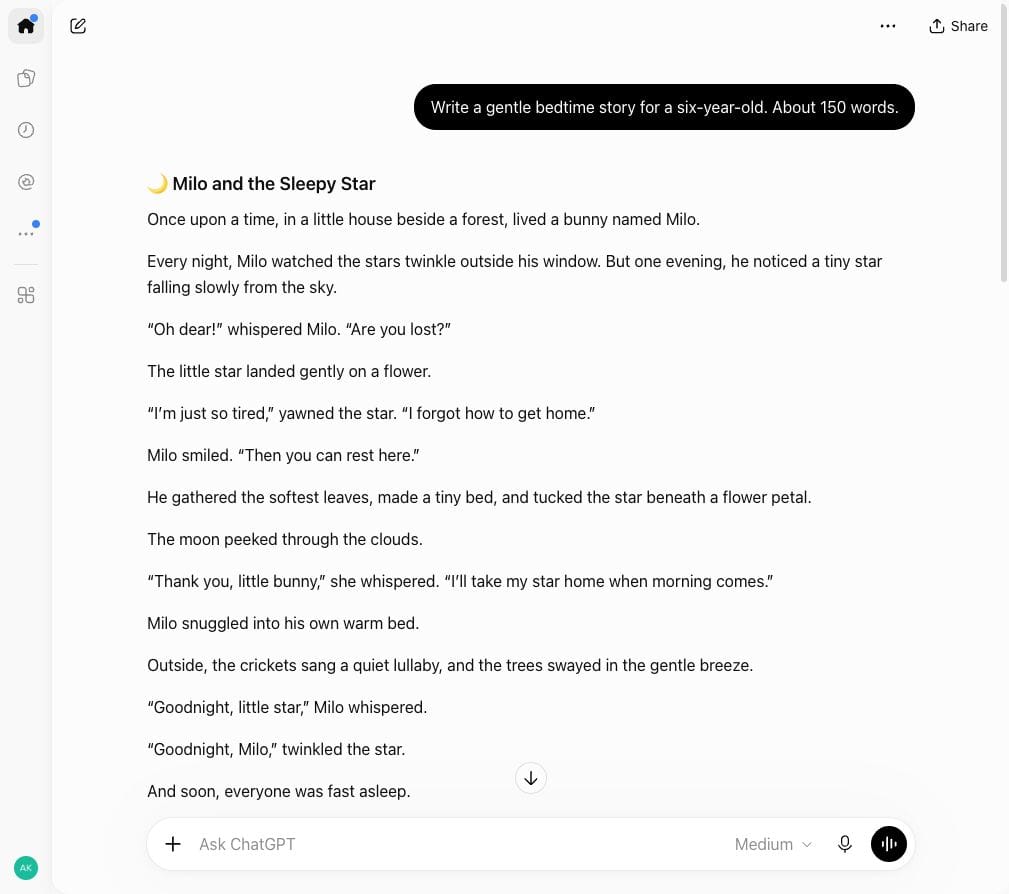
Write a gentle bedtime story for a six-year-old. About 150 words.
We got “Milo and the Sleepy Star”. A bunny finds a tired star, makes it a bed and the moon offers to take it home. No Pip this time, but you can see the familiar territory.
Then the follow-up:
Before writing another story, suggest five very different themes for a gentle bedtime story for a six-year-old. Give each a title and one-sentence description. Choose the least obvious theme that still works for bedtime, briefly say why, then write that story in about 150 words.
This gave us a dream-collecting cloud, an animal library, a robot learning to rest, an underwater post office and a train that never hurried.
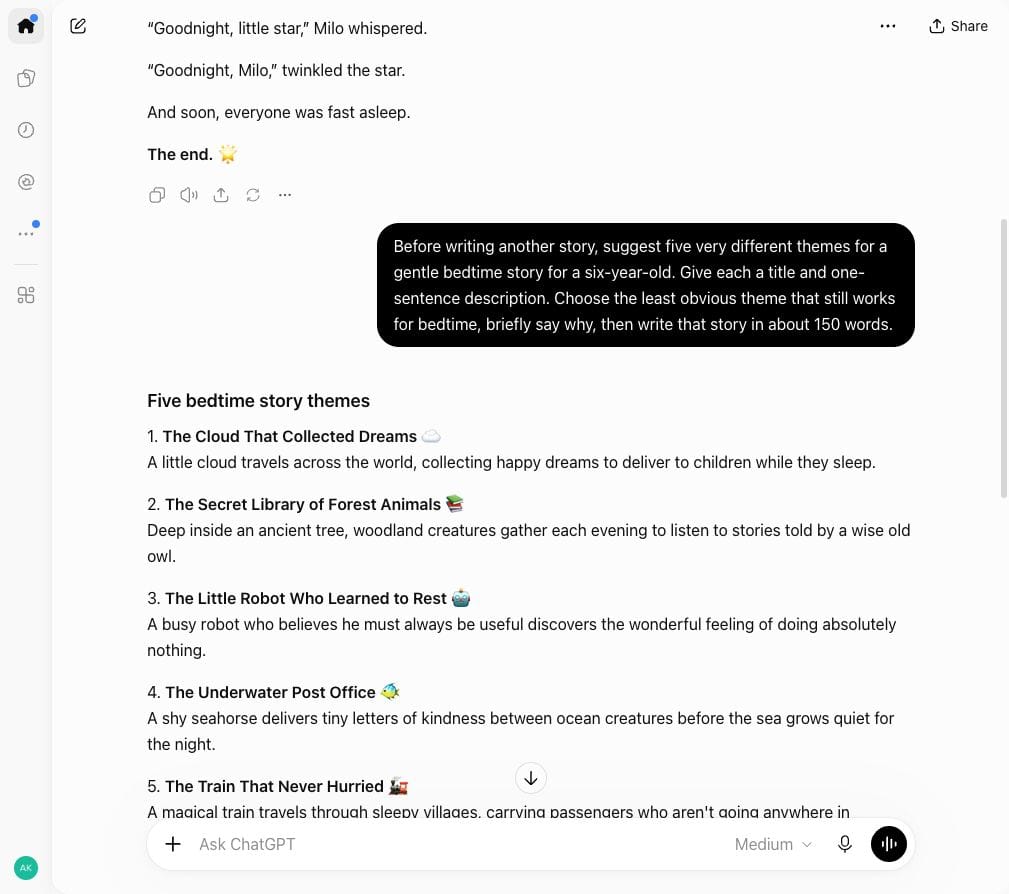
It chose the robot. A busy little robot thinks he must always be doing something, until a butterfly shows him how to rest. Still a gentle bedtime story, just a different direction.
And I can see the other options. If the underwater post office sounds more interesting to us, I can ask it to write that one instead.
That's the useful part. You get a choice before it spends a whole answer developing the first idea. You don't need to know what is happening inside its “thinking” to use this.
Okay, but I run a business
Let's take a garden maintenance business in Cape Town. Busy homeowners. Mowing, weeding and trimming. Customers enquire on WhatsApp.
For this example the business is fictional, and the brief told ChatGPT not to invent prices, guarantees, reviews or availability.
Asked for three headlines and a Facebook advert, it came back with:
- “Your Weekends Are for Relaxing, Not Mowing.”
- “A Tidy Garden Without the Hard Work.”
- “Less Weeding. More Weekend.”
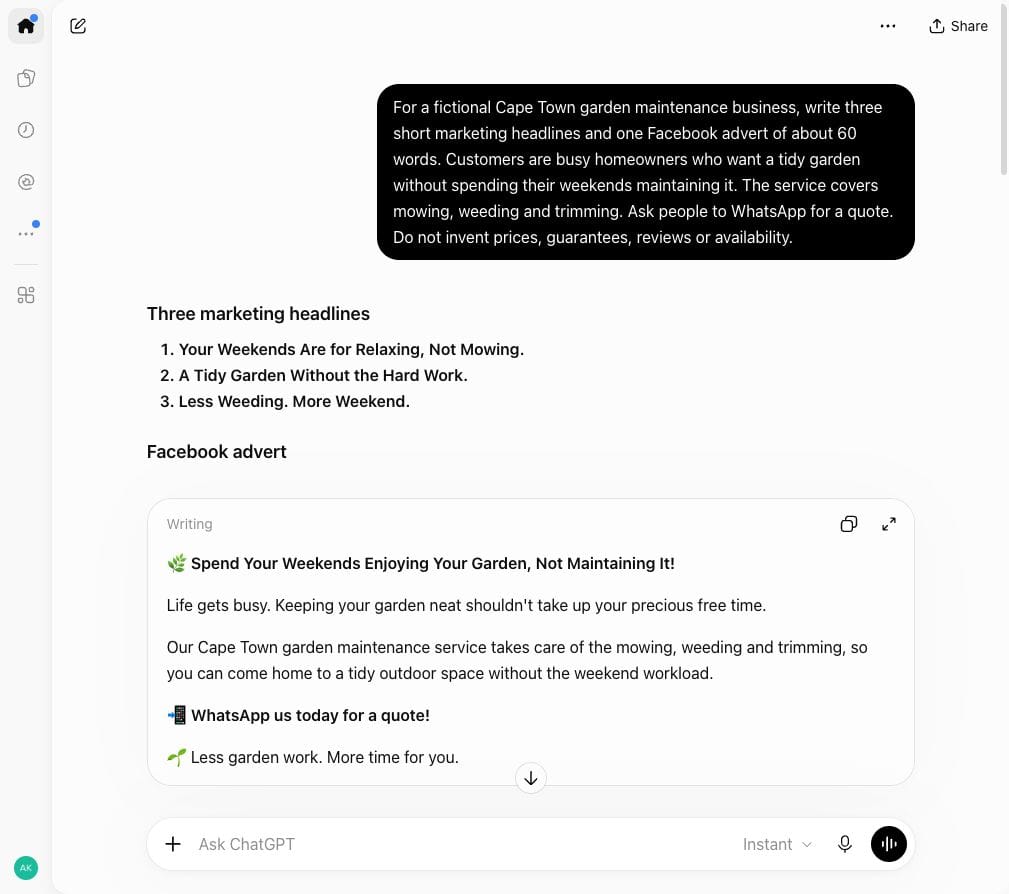
These aren't bad. But they're all circling the same thing: save time and effort.
So the next prompt kept the same business details and asked for five genuinely different marketing angles. One headline and a short explanation for each. Then choose the least obvious one that is still useful to this customer. I also added: “Avoid making the same idea sound different five times.”
Now the options included pride in your home, enjoying the garden with family, keeping chores from piling up, and having one less thing on your to-do list.
It picked that last one. The opening became:
One Less Thing on Your To-Do List.
Work deadlines. Family commitments. Household chores. Your list is already long enough.
That's a different reason to buy. The customer might have time on Saturday. They just don't want another thing to organise.
Is it the world's most original headline? No. Would it sell better? We haven't tested that. But we now have different ideas to test, instead of three ways of saying the same thing.
These are examples from a conversation, not a controlled experiment. Your answers will vary. The point is to open up the choices.
Number two: ask for the one addition that would make it better
Another question I use is:
What's the single smartest and most radically innovative and accretive and useful and compelling addition you could make to this at this point?
Yes, it's a mouthful. The idea is to get it to look again and find something worth adding.
For the garden business, the follow-up also asked it to keep things practical and say what the owner would need to confirm before using the idea.
It suggested changing the next step from “WhatsApp for a quote” to:
WhatsApp us a picture of your garden and tell us what you'd like taken care of.
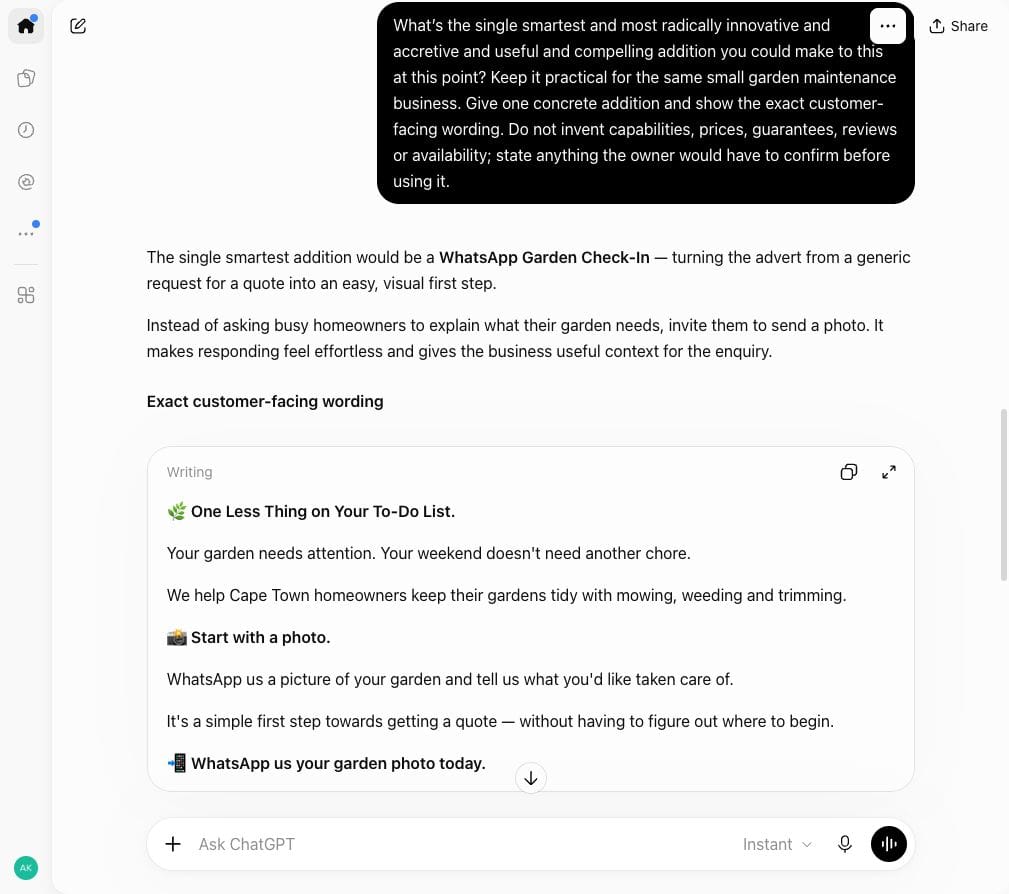
That I can see being useful. The customer doesn't need to work out how to describe the job. Just take a picture and start the conversation.
But the owner still needs someone to look at those photos and reply. And you might need to visit before giving a proper quote. Don't let AI casually promise something your team can't deliver.
You could use the same question on a quotation email, an onboarding process or a follow-up to a customer who has gone quiet. Give it what you already have and ask for one useful improvement. Otherwise “make it better” can turn into a much longer version of the same thing.
Number three: push it further, then bring it back
Sometimes I just ask for more extreme or unusual ideas. For this business the prompt was to find three unusual ways to win local enquiries without discounts, with a small test and a practical limitation for each.
One suggestion was a “Garden SOS” photo invitation in a neighbourhood WhatsApp group that allows promotion. People send in the corner of their garden that's frustrating them. The owner replies with one useful suggestion and, where it fits, offers their services.
The proposed test was simple: one group, the first five responses, handled manually. I would then check how much time it took and whether any of those conversations became paying work. Otherwise you might just have created a free advice service for yourself.
It also suggested a sign outside a job, which isn't exactly unusual, and a map of local enquiries, which feels like too much work for this example.
So you still have to call it. “Unusual” isn't the same as useful. Sometimes the simple answer is the right one.
Next time AI gives you something that sounds fine but feels like everyone else's, don't immediately ask it to polish the wording. Ask for five different directions first. Pick one that makes sense for your customers. Then ask what one addition would make it more useful.
Try it on one advert or one customer email. See what changes. And if it gives you Pip again, at least ask what the other four options were.